

What Does The Anther And Filament Makeup How Are Muscles Attached To Bones
Structure of Skeletal Muscle
A whole skeletal muscle is considered an organ of the muscular system. Each organ or musculus consists of skeletal muscle tissue, connective tissue, nerve tissue, and claret or vascular tissue.
Skeletal muscles vary considerably in size, shape, and arrangement of fibers. They range from extremely tiny strands such as the stapedium muscle of the middle ear to large masses such equally the muscles of the thigh. Some skeletal muscles are broad in shape and some narrow. In some muscles the fibers are parallel to the long axis of the muscle; in some they converge to a narrow attachment; and in some they are oblique.
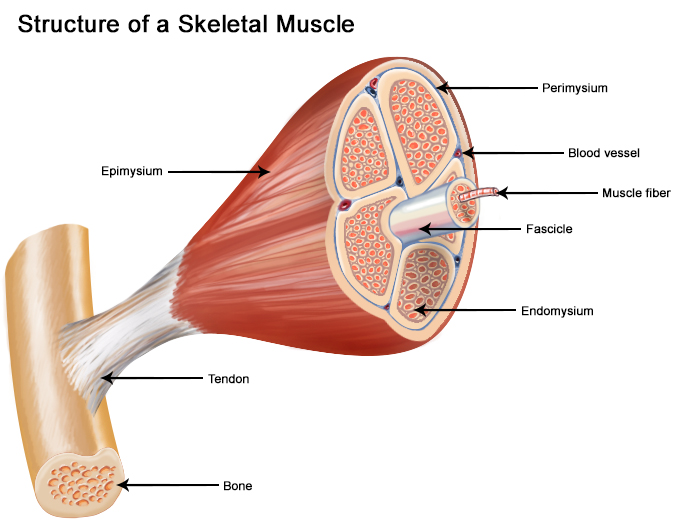
Each skeletal muscle cobweb is a single cylindrical muscle cell. An private skeletal muscle may be made up of hundreds, or fifty-fifty thousands, of muscle fibers bundled together and wrapped in a connective tissue covering. Each muscle is surrounded by a connective tissue sheath chosen the epimysium. Fascia, connective tissue outside the epimysium, surrounds and separates the muscles. Portions of the epimysium project inward to divide the musculus into compartments. Each compartment contains a bundle of muscle fibers. Each packet of muscle fiber is called a fasciculus and is surrounded by a layer of connective tissue chosen the perimysium. Within the fasciculus, each private musculus jail cell, called a muscle fiber, is surrounded by connective tissue called the endomysium.
Skeletal muscle cells (fibers), like other body cells, are soft and fragile. The connective tissue covering furnish support and protection for the delicate cells and allow them to withstand the forces of contraction. The coverings also provide pathways for the passage of blood vessels and nerves.
Normally, the epimysium, perimysium, and endomysium extend across the fleshy part of the muscle, the belly or gaster, to form a thick ropelike tendon or a broad, apartment sheet-like aponeurosis. The tendon and aponeurosis course indirect attachments from muscles to the periosteum of basic or to the connective tissue of other muscles. Typically a muscle spans a joint and is fastened to bones by tendons at both ends. One of the bones remains relatively fixed or stable while the other end moves as a result of muscle contraction.
Skeletal muscles have an arable supply of claret vessels and fretfulness. This is straight related to the primary function of skeletal musculus, contraction. Earlier a skeletal muscle cobweb can contract, it has to receive an impulse from a nervus jail cell. Generally, an avenue and at least one vein accompany each nervus that penetrates the epimysium of a skeletal musculus. Branches of the nerve and blood vessels follow the connective tissue components of the muscle of a nerve prison cell and with ane or more infinitesimal blood vessels called capillaries.
Source: https://training.seer.cancer.gov/anatomy/muscular/structure.html
Posted by: friedmanfrew1940.blogspot.com
0 Response to "What Does The Anther And Filament Makeup How Are Muscles Attached To Bones"
Post a Comment