

Inside the Plan to De-extinct the Tasmanian Tiger
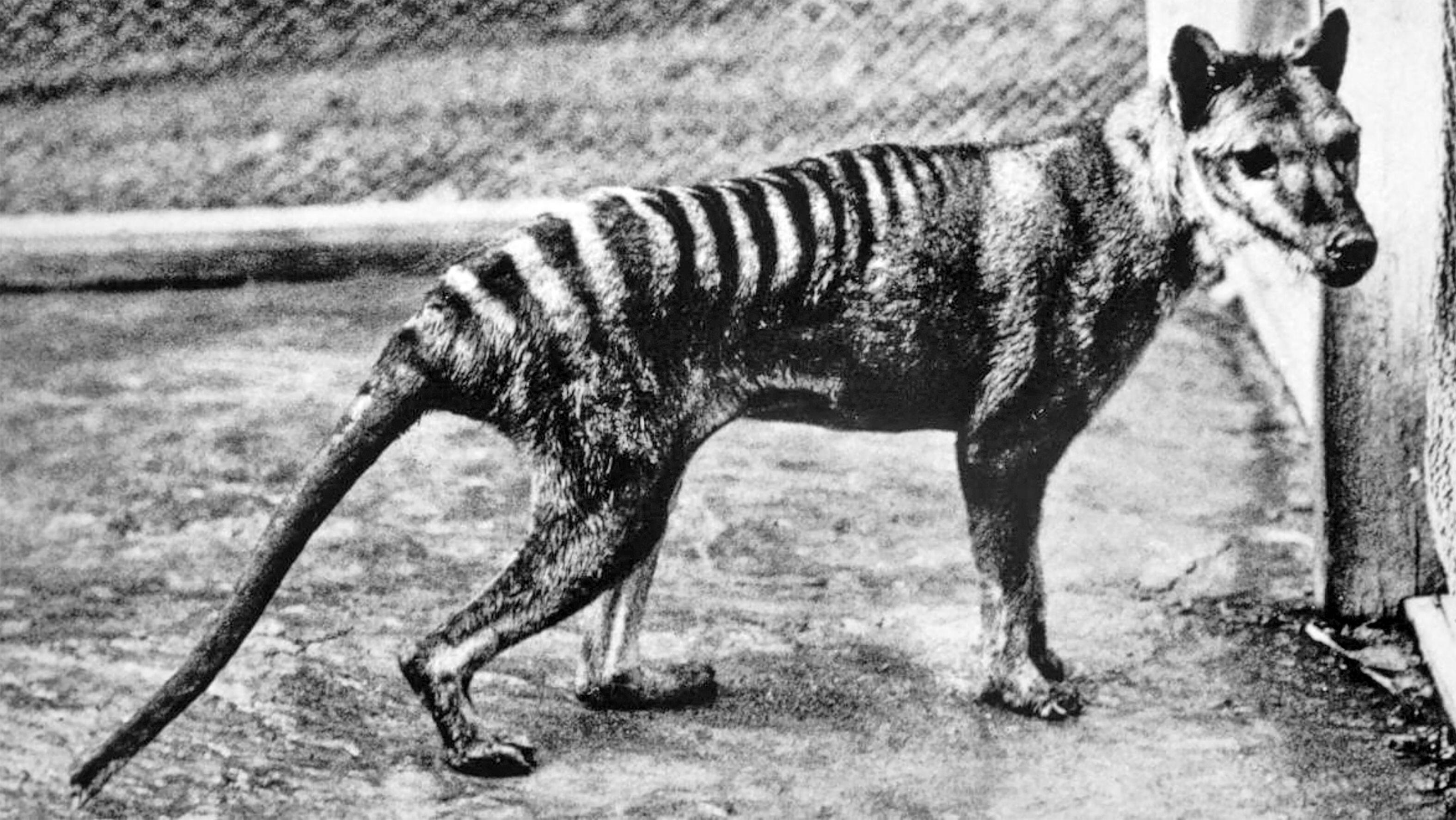
The thylacine has long been an icon of human-caused extinction. In the 1800s and early 1900s, European colonizers in Tasmania wrongly blamed the dog-sized, tiger-striped, carnivorous marsupial for killing their sheep and chickens. The settlers slaughtered thylacines by the thousands, exchanging the animals' skins for a government compensation. The concluding known thylacine spent its days pacing a zoo cage in Hobart, Tasmania, and died of neglect in 1936.
Now the wolflike creature—also known every bit the Tasmanian tiger—is poised to go an keepsake of de-extinction, an initiative that seeks to create new versions of lost species. Colossal Biosciences, a Texas-based de-extinction company that made headlines last September when it revealed that it planned to bring back the woolly mammoth, appear today that its 2d projection will be resurrecting the thylacine.
StuartHumphreys.jpg)
Australian scientists have been hoping since 1999 to use emerging genetic technologies to effort to bring the thylacine back from the expressionless. When the species went extinct, Tasmania lost its top predator. In theory, reintroducing proxy thylacines could help restore residuum to Tasmania's remaining forests by picking off sick or weak animals and controlling overabundant herbivores such as wallabies and kangaroos, some researchers say. Simply early attempts at cloning the animal from museum specimens' DNA failed, and the effort has not attracted pregnant funding—until this twelvemonth.
Colossal Biosciences, co-founded by Harvard University geneticist George Church and tech entrepreneur Ben Lamm, is working with the University of Melbourne'south Andrew Pask, who has already sequenced most of the thylacine genome. The thylacine is the perfect candidate for de-extinction, Pask says, considering it died out relatively recently, good-quality DNA is available, and its prey and parts of its natural habitat all the same exist.
In March his squad established the Thylacine Integrated Genetic Restoration Research Lab with a philanthropic gift of five million Australian dollars (virtually $3.6 million). Colossal is providing "more than that" sum, Pask says—he won't divulge exactly how much—likewise as access to equipment, another dedicated thylacine lab in Texas and a large team of researchers.
With this partnership established, Pask at present says it'south reasonable to expect to have "a de-extincted thylacine-ish affair" in a decade. That offset iteration might be "xc percent thylacine," he says, though the ultimate goal is more like 99.9 percent. Eventually—subsequently many years of monitoring the engineered animals in a large enclosed area—Colossal's goal is to release a viable, genetically-various population of perhaps 100 proxy thylacines into the wild.
To resurrect the woolly mammoth, Colossal'south researchers program to introduce mammoth genes into the genome of the Asian elephant, its closest living relative. They will then endeavor to create an embryo conveying that modified Dna that could gestate in an African elephant "surrogate" or an bogus uterus. The resulting animate being would not exist a mammoth per se but rather a cold-adapted "Artic elephant" with small ears, shaggy pilus, a domed forehead and curved tusks, Lamm says. Yet if he showed the creature to his grandmother, she'd say "that's a woolly mammoth," he adds.
Already, Lamm says, Colossal has fully sequenced the Asian and African elephant genomes, nerveless more than fifty mammoth genomes, and begun making edits to elephant cells—only he thinks the thylacine could turn out to be easier to revive than the mammoth because of the gestation times involved. Both projects still face many hurdles, however.
For the thylacine, the commencement task is to complete the sequencing of the animal'south genome. Pask'due south lab has nigh 96 percent of it down, just the final 4 percent is the trickiest, he says. "It'south like doing one of those horrible puzzles that's all baked beans or all blue sky. Every flake looks the aforementioned, and we're trying to figure out how it goes together."
Next the researchers will compare the genome of the thylacine to that of one of its closest living relatives: the fatty-tailed dunnart, a mouse-sized marsupial that is relatively abundant and copes well in captivity. Using CRISPR gene-editing technology, the scientists volition engineer the dunnart's genome to more closely resemble the thylacine'south.
The researchers have already figured out how to re-programme dunnart skin cells into stem calls, and are currently testing them to run across whether they're capable of generating an entire embryo—something that hasn't yet been washed in marsupials, which develop differently from placental mammals such as humans and mice. In one case they've fine-tuned the recipe, they'll exist able to use the stem cells to create a factor-edited living embryo they can insert into either a dunnart female parent or an artificial marsupial womb, which they would have to invent.
Thylacine pregnancies are estimated to last just a few weeks, compared with 22 months for mammoths. And like other newborn marsupials, the baby thylacines would be little larger than a grain of rice, so even a diminutive dunnart mother could nourish them in her pouch at first. But Lamm says Colossal will work on developing a synthetic pouch, also as a marsupial milk formula appropriate for each phase of development.
Collectively, these new marsupial reproductive technologies could go crucial tools for the conservation of extant species such every bit koalas or numbats, Pask says. "There is absolutely no fashion I would take the millions that I take now for marsupial conservation if I [wasn't] trying to bring the Tasmanian tiger dorsum," he says.
Other scientists are considerably less optimistic most the project. Mammal expert Kris Helgen of the Australian Museum, who worked on sequencing the thylacine'south mitochondrial genome in 2009, thinks altering the dunnart'south DNA to truly resemble a thylacine'southward will be an incommunicable feat. The two species are separated past every bit much as 40 million years of evolution, he says. Thylacines are so different other animals that they're in their ain taxonomic family, just as dogs are in one family of mammals and cats—from tigers to tabbies—are in some other. Turning a dunnart into a thylacine, Helgen says, would be the equivalent of editing a domestic dog'due south genome until the resulting beast looked like a cat. (Mammoths and elephants are far more closely related.)
Fifty-fifty if Colossal could overcome the technical challenges involved, the prospect of resurrecting the thylacine raises ethical concerns, according to Carol Freeman, an animal studies researcher at the Academy of Tasmania. "The whole discourse is well-nigh bringing this animal dorsum, only the welfare of the private animals isn't really talked most," she says. Both dunnarts and about-thylacines would inevitably endure in the course of these experiments, which "cannot be justified for such an uncertain result. Information technology would be many years, if ever, that cloned thylacines could have anything similar the life they may have had—and deserve—in the wild."
If the scientists exercise get to the point where they take actual living thylacines in paw, Pask says they would consult the public, including Indigenous communities, about any release. But Bradley Moggridge, a Kamilaroi ecology scientist at the University of Canberra in Australia, says Ethnic Australians should be involved at present—especially Tasmanian Aboriginal peoples, who were themselves hunted by white settlers in the 19th century. "They may have ideas; they might need to become [their traditional lands] ready for this species. That could take a long fourth dimension," he says. Discussions between the Colossal team and Indigenous Australians could exist beneficial for everyone, Moggridge says. Aboriginal ecological noesis almost the thylacine would have been encoded in stories and songs, and de-extinction could reignite some of them, but the researchers "need to start those conversations now."
Other critics worry the glamour of de-extinction will rob attending and funding from conservation projects. One study in 2017 establish that allocating sums to existing endangered species programs rather than giving the same amount of coin to de-extinction efforts would see virtually ii to eight times as many species saved. "Information technology'south better to spend the money on the living than the expressionless," lead author Joseph Bennett of Carleton Academy in Ontario told Science.
The idea that science could restore the thylacine "is just so lovely; it captures the imagination," says Helgen, who once made a pilgrimage to visit every museum specimen of the animate being in existence. "Merely the thylacine is extinct in Australia and in Tasmania, and there'southward no way to bring it back." Some species are simply gone forever considering of how unique they were, and the thylacine is one of them, he says. "A few meg dollars [are] not going to give us an escape hatch from extinction."
Source: https://www.scientificamerican.com/article/de-extinction-company-aims-to-resurrect-the-tasmanian-tiger/
Posted by: friedmanfrew1940.blogspot.com
0 Response to "Inside the Plan to De-extinct the Tasmanian Tiger"
Post a Comment